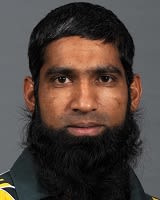
Full Name: Fawad Alam
Date of Birth: Oct 08, 1985, Karachi
Major Team: Pakistan, Karachi Cricket Association Under-19s, Karachi Dolphins, National Bank of Pakistan, Pakistan Customs, Pakistan Emerging Team
Playing Roll: All Rounder
Batting Style: Left
Bowling Style: Slow left-arm orthodox
Ali Azhar
Born with a multi-ethnic background, Ali Azhar was destined to stand out from the crowd since day one. In addition to growing up in family of engineers from India, Azhar is also the grandson of a carpenter from the Island of Haiti. With ingenuity running through his veins it's no wonder that Azhar learned the value of working with his hands at a very early age. His earliest memories are of taking things apart and trying to figure out ways to fix them and make them better. As Azhar got older he realized that he most likely would not become an engineer like his brothers and chose to focus more on his creative skills. “I’ve always had an eye for design and I have always been good with my hands. So I guess it was only natural that my path led me down the road to be a designer and Co-host of HGTV’s Design on a Dime,” said Azhar. His role requires him to be well versed in design, but at the same time a skilled carpenter and furniture builder who is creative and resourceful enough to create projects that have a high-end look without the high-end price tag.
Over the years Azhar has filmed over 78 episodes of Design on a Dime serving as a driving force behind the quality makeovers on each show. With the constant challenge of constructing a room on a budget, each episode ignites the creative juices and requires Azhar to maximize his problem solving skills. Aside from his interest in residential design, Azhar also enjoys the challenge working with commercial clients at his Interior design consulting firm Alive Design llc .When not filming; Azhar can be found designing a new piece for his line of sustainable and environmentally friendly furniture or putting the finishing touches on one of his tile mosaic masterpieces.
Recently, Azhar has been featured in the pages of Shore magazine. They named him a “Chicago Style Icon”. CS magazine then chose him for their “Men of Style” issue, which has started Ali in the new career of modeling. From host to designer and now model, Ali is filled with energy and excitement and is always looking for new challenges.
Ali Azhar
Ali Azhar
Ali Azhar
Ali Azhar
Ali Azhar
Ali Azhar
Ali Azhar
Ali Azhar
Ali Azhar
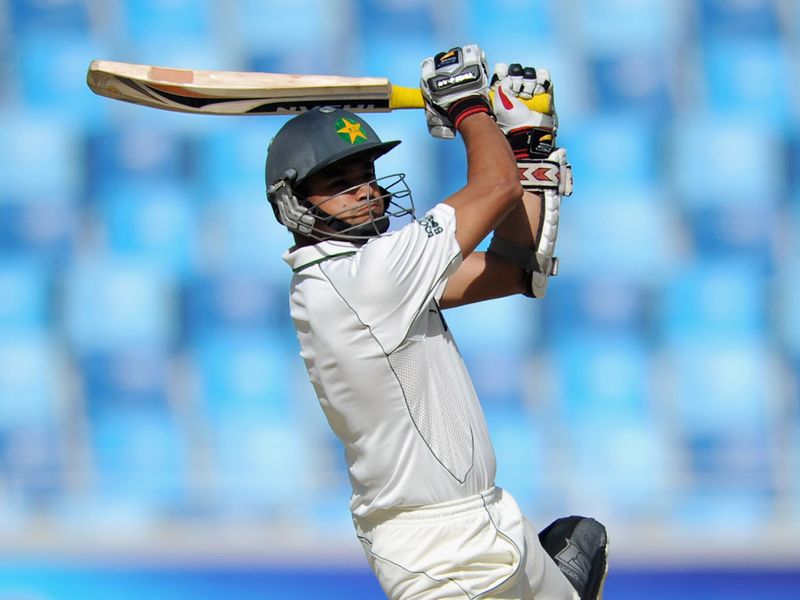
AZHAR ALI MAKES HIS 2ND TEST HUNDRED AGAINST ENGLAND
Azhar Ali 157 Vs Engalnd 3rd Test 2012 Pakistan Vs England Dubai
Imran Farhat Biography
Imran Farhat (born 20 May, 1982 in Lahore) is a Pakistani cricketer who has played 20 Tests and 26 one-day internationals for Pakistan, opening the batting in 47 of his 49 international innings.
When in form, Farhat is an excellent player of the pull shot. However, he has the tendency to fall for one too many. A fine player of the drives either side of the wicket Farhat made his senior debut aged 15 in a one-day match for Lahore City against Malaysia, together with three other players who went on to play Test cricket (Taufeeq Umar, Bazid Khan and Kamran Akmal). Three years later, in February 2001, Farhat made his one-day international debut, against New Zealand in Auckland, scoring five runs in a chase of 150 to win. After the tour of New Zealand, where Farhat played three Tests and three ODIs, he was sent back to domestic cricket before returning against Australia in the third Test of the 2002–03 series, where he made 29 and 18 in an innings defeat. However, he was retained for the home two-Test series against South Africa in 2003–04, where he scored 235 runs including a maiden Test century in a 1–0 series win, second behind fellow opener Taufeeq Umar.
A month later, Farhat played in an ODI-only series against New Zealand, which Pakistan won 5–0, and Farhat made three fifties along with his second international century, ending with 348 runs at a batting average of 69.60, once again the second-highest amount of runs — this time behind Yasir Hameed. The season was rounded off with another century, this time against India, where he made 101 to help Pakistan gain a 202-run first-innings lead and eventually won the match by nine wickets. However, Farhat tallied 81 runs in the other two matches, which Pakistan lost to lose the series 1–2.
Farhat was less impressive the following season, however, and in four Tests, two against Sri Lanka and two against Australia, he only passed fifty twice, ending the season with 199 runs at 24.87 before the selectors left him out for the third Test of the series with Australia. In September 2004, just before the 2004–2005 season, he had been dropped from the ODI side following the 2004 Champions Trophy, as he had failed to pass 40 with any of his last ten innings, and that included 38 not out against the non-Test nation of Kenya, 20 against ODI debutants Hong Kong and 24 against bottom-ranked Bangladesh.
He continued to score heavily in the domestic competitions and a century in a practise game against the visiting Indian team was rewarded with a place in the squad to take on India in the Test series (2006). He returned to Test cricket in style, with an important half century in the deciding third Test at Karachi.
Imran Farhat
Imran Farhat
Imran Farhat
Imran Farhat
Imran Farhat
Imran Farhat
Imran Farhat
Imran Farhat
Imran Farhat
Interview of Imran Farhat Attari ( Cricketer )at Madani Channel ( 1 of 2)
Interview of Imran Farhat Attari ( Cricketer )at Madani Channel ( 2 of 2)
Major teams Pakistan, Essex, Habib Bank Limited, Karachi, Pakistan National Shipping Corporation, Pakistan Reserves
Nickname Nani-Danny
Batting style Right-hand bat
Bowling style Legbreak
Danish Kaneria will end his career as the highest wicket-taking spinner for Pakistan - itself an achievement - but whether or not he will be the best this country has ever produced will not be as straightforward a conclusion.
Kaneria, only the second Hindu to play for Pakistan, has many admirable traits, many necessary to make a good legspinner. His height purchases good bounce - though not always flight - and he can turn the ball significantly. Though the googly is overexposed, Richie Benaud once reckoned it to be among the best-disguised he had seen. Above all he has perseverance, and right or wrong, has served often as shock and stock bowler.
But something has been missing, the unknown that makes great leggies great. It is not so much in the tools, but in the persona and a peculiar lack of guile, especially if he is to be compared to countrymen such as Abdul Qadir and Mushtaq Ahmed; both had a wonderful presence. In turn he has also lacked a good captain, or always good supporting bowlers at the other end. Latterly he has suffered the lack of even an able wicketkeeper.
He has been an ever-present in the Test side since 2004 and his best period was in the years that followed immediately; critical spells came around the world, against Sri Lanka, England and West Indies and lionhearted ones against Australia and India. But he hasn't kicked on since. Often he will turn an innings, bowling as brightly as Pakistan has always hoped. But mostly he is a reliable run-controller and his strike rate has expanded alarmingly over the years. Tellingly, perhaps, he hasn't been part of Pakistan's limited-overs thinking at all for years.
Because he is left-handed and possessed of some supple wrists, it is easy to compare Salman Butt with the delightful Saeed Anwar. His drives and cuts through the arc between extra cover and backward point are inevitably flicked, often scooped and it is a high-scoring region. He doesn't mind pulling either and off his toes, he is efficient rather than whippy as Anwar was. Further, like Anwar, Butt's footwork doesn't really hold him back. But in attitude and temperament Butt is more Anwar's long-time partner, Aamir Sohail.
He has a confident air about him, a spikiness and is one of the few younger players confident when speaking English. His breakthrough period was the winter of 2004, where he first scored an ODI century against India at Eden Gardens and then went further by scoring a fifty and a maiden Test century in Sydney later in the year. For most of 2005, he failed to build on that and despite another ODI century, also against India, doubts about his defensive technique and overt dash crept in, resulting in him dropping in and out of the team. But against England to end the year, he responded to criticism by unveiling a startling restraint and change of tempo, hitting a century and two fifties in the Tests, each innings commendably restrained. Though his consistency isn't up to the mark, he still remains a vital member of the Test team. Following the disastrous tour of Australia in 2009-10, where senior players were slapped with serious punishments by the PCB, Butt came through unharmed and was given the vice- captaincy for the Asia Cup and England tour in 2010.
He had made impressive strides at age-level matches before making his Test debut against Bangladesh in 2003-04, playing in the Under-19 World Cup and touring South Africa with Pakistan's Academy team, smashing 233 against the South African Academy side. His strokeplay has never been in doubt and he is capable of providing electrifying starts when needed but with the tightening of his defense, Butt could be one half of the opening conundrum that has so haunted Pakistan since...well, Anwar and Sohail left the scene.
2010 became a significant year for him as he finally cemented his place in all three formats and eventually succeeded Shahid Afridi as Test captain. But after winning much praise for his leadership on and off the field - and leading Pakistan to Test wins against Australia and England - his career was rocked by charges of involvement in spot-fixing and, in February 2011, he was handed a ten-year ban (with five years suspended) by the ICC.
Salman Butt
Salman Butt
Salman Butt
Salman Butt
Salman Butt
Salman Butt
Salman Butt
Salman Butt
Salman Butt Salman butt 72 vs Australia ist odi jan 2010...!
Muhammad N. Yousaf was born in Pakistan and moved to Toronto Canada with his family at an early age. He did all his formal education in Toronto and studied inorganic chemistry at York University in Toronto as an undergraduate with Prof. Dennis Stynes. He then moved to the US and pursued his PhD studies in surface chemistry and material science at the University of Chicago with Milan Mrksich followed by a cell biology postdoctoral fellowship at Harvard University with Marc Kirschner.
Dr. Yousaf has recently returned to his hometown of Toronto and his alma mater and is currently a Professor in the Department of Chemistry and Biology at York University (2011). He previously was on the faculty at the University of North Carolina at Chapel Hill (USA) (2005-2011). His research interests are in interfacing organic, bioanalytical, bioengineering and cell biology research to study fundamental cell behavior and to develop new biomaterials and tools for regenerative medicine applications.
As a PI since 2005, he has published more than 60 original papers, given over 100 seminars at universities and conferences including plenary and named lectureships and has been elected to serve on 5 journal advisory and editorial boards. He is the founding Editor in Chief of the journal Bio-orthogonal chemistry (launch 2012) and Editor in Chief for the American Journal of Molecular and Cellular Biology. His research has been highlighted multiple times in Nature, Science and Chemical and Engineering News and several print and online media circulars. Dr. Yousaf has received several national USA awards including, a Damon Runyon Fellowship, Burroughs Wellcome Interface Career Award and an NSF CAREER award. Dr. Yousaf is very proud of his highschool, undergraduate and graduate students who have also received numerous national awards including, Barry Goldwater Award, Churchill Scholar (Cambridge), NSF Predoctoral Fellowship, Westinghouse Awards and a Nobel Laureate Lindau Meeting award.
Muhammad N. Yousaf
Department of Chemistry E-mail: mnyousaf@yorku.ca
Centre for Research on Biomolecular Interactions
York University Telephone: (416) 736-2100 ext-77712
Toronto, ON, Canada
M3J 1P3 Cell: (647) 972-2745
BIOGRAPHICAL SKETCH
NAME
Muhammad Naveed Yousaf
POSITION TITLE
Associate Professor, Dept. of Chemistry, Biology, York University, Toronto, Canada
EDUCATION/TRAINING
INSTITUTION AND LOCATION
DEGREE
(if applicable)
YEAR(s)
FIELD OF STUDY
Harvard University, Boston, MA
2001-04
Postdoc (Cell Biology)
University of Chicago, Chicago, IL
Ph.D.
2001
Chemistry/Materials
University of Massachusetts
M.S.
1996
Chemistry
York University, Toronto, Canada
B.Sc. (Hon)
1994
Chemistry/Biology
1. Personal. Married with two children
Research Interests: Surface Chemistry, Nanoscience, Biomaterials, Chemical Biology, Cell Biology.
2. Education
2004 Postdoctoral Fellow; Harvard University Medical School, Boston, MA (Advisor: Marc W. Kirschner)
2001 Ph.D. in Chemistry; University of Chicago, Chicago, IL (Advisor: Prof. Milan Mrksich)
1996 M.S. in Chemistry; University of Massachusetts, MA
1994 B.Sc (Hon); York University, Toronto, ON, Canada
3. Professional Experience
2011 - present Associate Professor, Department of Chemistry, York University, Toronto, Canada
2005 - 2011 Assistant Professor, Department of Chemistry, Carolina Center for Genome Science, Lineberger
Cancer Center, University of North Carolina, Chapel Hill, NC, USA
2003 - 2004 Instructor, Institute of Chemistry and Cell Biology, Harvard University, Boston, MA.
2001 - 2003 Postdoctoral Fellow, Department of Cell Biology, Harvard University, Boston, MA.
4. Honors and Memberships:
2012 Editor in Chief for American Journal of Molecular and Cellular Biology
2011 Chemical and Engineering News Highlight - C&E News 2011, 49, 36.
2011 Guest Editor International Journal of Analytical Chemistry (Biomaterials)
2011 Editor in Chief, Bio-orthogonal Chemistry Journal (Springer) - Launch in 2012
2011 Chemical and Engineering News Highlight – C&E News 2011, 29, 27.
2003 News of the Week, Chemical and Engineering News 2003, 81, 11
2001 News of the Week, Chemical and Engineering News 2001, 79, 13
2001 Nature News Wire March 27, 2001.
2000 News of the Week, Science 2000, 1477
1999 Chemical and Engineering News Highlight 1999, 77, 11
1995-1996 John Masteracola Memorial Award for Excellence in Graduate Research
5. Publications (* denotes independent publications as a Faculty since 2005)
a) Published, In press Refereed Papers
*59 Cell Surface Engineering via Liposome Fusion. D. Dutta, A. Pulsipher, W. Luo, M.N. Yousaf*. Bioconjugate Chemistry. 2011, 22, 2423-2433.
Highlighted in C&E News 2011, 49, 36.
*58 Biomolecular modification of carbon nanotubes for studies of cell adhesion and migration. W. Luo, M.N. Yousaf. Nanotechnology. 2011. In press. (Cover Article) (Special Issue on Bioengineering Nanotechnology)
*57 Tissue Morphing Control on Dynamic Gradient Surfaces. W. Luo, M.N. Yousaf*. J. Am. Chem. Soc. 2011, 133, 10780-10783.
Highlighted in C&E News 2011, 29, 27.
*56. A Redox Switchable Surface for Controlling Peptide Structure. B. M. Lamb, M.N. Yousaf*. J. Am. Chem. Soc. 2011, 133, 8870-8873.
*55. Synthetic Chemoselective Rewiring of Cell Surfaces: Generation of Three-Dimensional Tissue Structures. D. Dutta, A. Pulsipher, W. Luo, M. N. Yousaf*. J. Am. Chem. Soc. 2011, 133, 8704-8713.
Highlighted in Science 2011, 332, 1011-1012.
*54. A Renewable, Chemoselective, and Quantitative Ligand Density Spot Microarray for the Study of High-Throughput Biospecific Interactions. A. Pulsipher and M.N. Yousaf*. Chem. Comm. 2011. (Special Issue on Emerging Investigators) 47, 523-525
*53. Developing A Self-Assembled Monolayer Microarray to Study Stem Cell Differentiation. W. Luo, M.N. Yousaf*, J. Coll. Int. Sci. 2011. 360, 325-330. (Cover Article)
*52. One-Step Syntheses of Photocurable Polyesters Based on a Renewable Resource. D. Barrett, T. Merkel, C. Luft, M.N. Yousaf*. Macromolecules. 2010, 43 ,9660–9667
*51. Thermosets Synthesized by Thermal Polyesterification for Tissue Engineering Applications. D.G. Barrett, M.N. Yousaf*. Soft Matter (Special Issue on Tissue Engineering) 2010, 6, 5026 – 5036.
*50. Microfluidics for Molecular Interaction Assays on Surfaces. B.M. Lamb and M.N. Yousaf*. Methods in Molecular Biology (Chemical Genomics and Proteomics). Book Chapter. Editor. E. Zanders. 2010. in press.
*49. Fabrication of Dynamic Self-Assembled Monolayers for Cell Migration and Adhesion Studies. N. P. Westcott and M.N. Yousaf*. Methods in Molecular Biology (Bioconjugation Protocols). Book Chapter. Editor. S. Mark. 2010. in press.
*48. Self-Assembled Monolayers as Dynamic Model Substrates for Cell Biology. Pulsipher, M. N. Yousaf. * Advances in Polymer Sciences (Bioactive Surfaces). Book Chapter. Editors. Borner, Lutz. 2010. 1-32, DOI: 10.1007/12_2010_87
*47. Microfluidic Permeation Printing of Self-Assembled Monolayer Gradients on Surfaces for Chemoselective Ligand Immobilization Applied to Cell Adhesion and Polarization B.M. Lamb and M.N. Yousaf*. Langmuir. 2010, 26, 12817-12823.
*46. Selective Tethering of Ligands and Proteins to a Microfluidic Patterned Electroactive Fluid Lipid Bilayer Array. D. Dutta, A. Pulsipher and M.N. Yousaf*. Langmuir, 2010. 26, 9835-9841.
*45. Role of Surface Chemistry and Topology of Chemoselectively Tailored Embossed Films on Shear Adhesion. D. G. Barrett and M.N. Yousaf*. J. Mat. Chemistry. 2010, 20, 2813-2819.
*44. Tandem Surface Microfluidic Lithography and Activation to Generate Patch Pattern Biospecific Ligand and Cell Arrays. A. Pulsipher and M. N. Yousaf*. Langmuir, 2010, 26, 4130-4135.
*43. Aliphatic Polyester Elastomers Derived from Erythritol and α,ω-Diacids. D. G. Barrett and M. N. Yousaf*, Polymer Chemistry 2010, 1, 296-302.
*42. Surface Chemistry and Cell Biological Tools for the Analysis of Cell Adhesion and Cell Migration. A. Pulsipher, M.N. Yousaf*. ChemBioChem 2010, 11, 745-753. (Cover Article)
*41. Tailored Electroactive and Quantitative Ligand Density Microarrays Applied to Stem Cell Differentiation. W. Luo, E.W.L. Chan and M.N. Yousaf*. J. Am. Chem. Soc. 2010, 132, 2614–2621.
Highlighted in J. Am. Chem. Soc. 2011, 133, 167-169. (JACS SELECTS #11)
*40. Design and Applications of Biodegradable Polyester Tissue Scaffolds Based on Endogenous Monomers Found in Human Metabolism. D. G. Barrett, M. N. Yousaf*. Molecules 2009, 14, 4022-4050
*39. Patterned Hybrid Nanohole Array Surfaces for Cell Adhesion and Migration. N. P. Westcott, Y. Lou, J. F. Muth and M. N. Yousaf*. Langmuir 2009, 25, 11236–11238.
*38. Spatio-Temporal Control of Cell-Cell Interactions on Surfaces. E.J. Lee, E.W.L. Chan, M.N. Yousaf*. ChemBioChem 2009, 10, 1648-1653.
*37. Chemoselective Ligand Patterning of Electroactive Surfaces using Microfluidics. N. P. Westcott, M. N. Yousaf*. Electrophoresis 2009, 30, 3381-3385. (Cover Article)
*36. Electrochemical and Chemical Microfluidic Gold Etching to Generate Patterned and Gradient Substrates for Cell Adhesion and Cell Migration. N. P. Westcott, B.M. Lamb, M.N. Yousaf*. Analytical Chem. 2009. 81, 3297–3303.
*35. Rapid In-Situ Generation of Two Patterned Chemoselective Orthogonal Surface Chemistries from a Single Hydroxy-Terminated Surface Using Controlled Microfluidic Oxidation. A. Pulsipher, N.P. Westcott, W. Luo, M.N. Yousaf*. J. Am. Chem. Soc. 2009. 131, 7626–7632.
*34. Model Systems for Cell Mobility. M.N. Yousaf*. Curr. Opin. Chem. Bio. 2009. 13, 697-704.
*33. Tailored Electroactive Nanorods for Biospecific Cell Adhesion and Differentiation. W. Luo, M.N. Yousaf*. Chem. Comm. 2009, 10, 1237-1239.
*32. Rapid Microfluidic Generation of Patterned Aldehydes from Hydroxy Terminated SAMs for Ligand and Cell Immobilization on Optically Transparent Indium Tin Oxide (ITO) Surfaces. A. Puslipher, N.P. Westcott, W. Luo, M.N. Yousaf*. Adv. Materials. 2009, 21, 3082-3086.
*31. Total Internal Reflection Fluorescence Microscopy of Cell Adhesion on Patterned Self-Assembled Monolayers on Gold. D. Hoover, E.J. Lee, M.N. Yousaf*. Langmuir 2009, 25, 2563-2566.
*30. Geometric Control of Stem Cell Differentiation Rate on Surfaces. W. Luo, S. Jones, and M. N. Yousaf*. Langmuir 2008, 24, 1229-1233.
*29. An Electroactive Catalytic Dynamic Substrate that Immobilizes and Releases Patterned Ligands, Proteins and Cells. E.W.L. Chan, S. Park, M.N. Yousaf *. Angew. Chem. Int. Ed. 2008, 47, 6267-6271.
*28. Renewable and Optically Transparent Electroactive Indium Tin Oxide (ITO) Surfaces for Chemoselective Ligand Immobilization and Biospecific Cell Adhesion. W. Luo, N. P. Westcott, A. Pulsipher, and M. N. Yousaf*. Langmuir 2008, 24, 13096-13101.
*27. Poly(triol-α-ketoglutarate) as Biodegradable, Chemoselective, and Mechanically Tunable Elastomers. D.G. Barrett and M.N. Yousaf*. Macromolecules 2008, 41, 6347-6352.
*26. Microfluidic Lithography to Create Dynamic Gradient SAM Surfaces for Directed Cell Migration. B. M. Lamb, N. P. Westcott, M. N. Yousaf*. ChemBioChem 2008, 9, 2628-2632.
*25. Expedient Generation of Patterned Surface Aldehydes by Microfluidic Oxidation for Chemoselective Immobilization of Ligands and Cells. N. P. Westcott, A. Pulsipher, B. M. Lamb, M. N. Yousaf*. Langmuir 2008, 24, 9237-9240.
*24. Asymmetric Peptide Nanoarray Surfaces for Studies of Single Cell Polarization. D.K. Hoover, E.W.L. Chan and M.N. Yousaf*. J. Am. Chem. Soc. 2008, 130, 3280-3281.
Highlighted in Faculty of 1000.
*23. Live-Cell Fluorescence Microscopy of Directed Cell Migration on Partially Etched Electroactive SAM Gold Surfaces. B.M. Lamb, N.P. Westcott, M.N. Yousaf*. ChemBioChem 2008, 9, 2220-4.
*22. Microfluidic Etching and Oxime-Based Tailoring of Biodegradable Polyketoesters. D.G. Barrett, B.M. Lamb, M. N. Yousaf*. Langmuir 2008, 24, 9861-9867.
*21. Microfluidic Lithography of SAMs on Gold to Create Dynamic Surfacesfor Directed Cell Migration and Contiguous Cell Co-Cultures. B.M. Lamb, D.G. Barrett, N.P. Westcott, M .N. Yousaf*. Langmuir 2008, 24, 8885-9.
*20. Preparation of a Class of Versatile, Chemoselective, and Amorphous Polyketoesters D. G. Barrett and M. N. Yousaf*. Biomacromolecules 2008, 9, 2029-2035.
*19. An Interfacial Oxime Reaction to Immobilize Ligands and Cells in Patterns and Gradients to Photo-Active Surfaces. S. Park, M.N. Yousaf*. Langmuir 2008, 24, 6201-6207.
*18. A Photo-Electroactive Surface Strategy for Immobilizing Ligands in Patterns and Gradients for Studies of Cell Polarization. E.W.L. Chan and M.N. Yousaf*. Mol. BioSys. 2008, 4, 746-753.
*17. Synergistic Microfluidic and Electrochemical Strategy to Activate and Pattern Surfaces Selectively with Ligands and Cells. N.P. Westcott and M.N. Yousaf*. Langmuir 2008, 24, 2261-2265.
*16. A Tunable, Chemoselective and Moldable Biodegradable Polyester for Cell Scaffolds. D.G. Barrett and M.N. Yousaf*. ChemBioChem. 2008, 9, 62-66.
*15. Combining Surface Chemistry with a FRET-Based Biosensor to Study the Dynamics of RhoA GTPase Activation in Cells on Patterned Substrates. L.Hodgson, E.W.L. Chan, K.M. Hahn and M.N. Yousaf*. J. Am. Chem. Soc. 2007, 129, 9264-9265.
*14. Rapid Patterning of Cells and Cell Co-Cultures with Spatial and Temporal Control on Surfaces through Centrifugation. D.G. Barrett and M.N. Yousaf*. Angew. Chem. Int. Ed. 2007, 46, 7437-7439.
*13. Surface-Chemistry Control to Silence Gene Expression in Drosophila Schneider 2 Cells through RNA Interference. E.W.L. Chan and M.N. Yousaf*. Angew. Chem. Int. Ed. 2007, 46, 3881-3884.
*11. Site-Selective Immobilization of Ligands with Control of Density on Electroactive Microelectrode Arrays. E.W.L. Chan and M.N. Yousaf*. ChemPhysChem 2007, 8, 1469-1472.
*10. Selective Immobilization of Ligands, Proteins and Cells to Electroactive Surfaces. E.W.L. Chan and M.N. Yousaf*. J. Am. Chem. Soc. 2006, 128, 15542-15546.
Highlighted in Faculty of 1000. Nanowerks.
9. A Photochemical Method for Patterning the Immobilization of Ligands and Cells to Self-Assembled Monolayers W. S. Dillmore, M.N. Yousaf and M. Mrksich Langmuir 2004, 20, 7223-7231.
8. Dynamic Interfaces Between Cells and Surfaces: Electroactive Substrates that Sequentially Release and Attach Cells. W.S. Yeo, M.N. Yousaf, M. Mrksich. J. Am. Chem. Soc., 2003, 125,14994-14995.
Featured in: News of the Week, Chemical Engineering News 2003, 81, 11
7. Using Electroactive Substrates to Pattern the Attachment of Two Different Cell Types. M.N. Yousaf, B.T. Houseman and M. Mrksich Proc. Natl. Acad. Sci. (USA) 2001, 98, 5992-5996.
6. Turning on Cell Growth with Electroactive Substrates. M.N. Yousaf, B.T. Houseman and M. Mrksich Angew. Chem. Int. Ed. 2001, 40, 1093.
Featured in: News of the Week, Science 2000, 1477
Nature News Wire March 27, 2001.
News of the Week, Chemical and Engineering News 2001, 79, 13
5. Understanding the Role of Adsorption in the Reaction of Cyclopentadiene with an Immobilized Dienophile. E.W.L. Chan, M.N. Yousaf and M. Mrksich J. Phys. Chem. A. 2000, 104, 9315.
4. The Kinetic Order of an Interfacial Diels-Alder Reaction Depends on the Environment of the Immobilized Dienophile. M.N. Yousaf, E.W.L. Chan and M. Mrksich Angew. Chem. Int. Ed. 2000, 39, 1943.
3. Diels-Alder Reacton for the Selective Immobilization of Protein to Electroactive Substrates. M.N. Yousaf and M. Mrksich J. Am. Chem. Soc. 1999, 121, 4286.
Featured in: Science Concentrates, Chemical and Engineering News 1999, 77, 11
2. Modulating the Behaviors of Attached Cells with Dynamic Substrates. M.N. Yousaf and M. Mrksich New Technologies for Life Sciences. A Trends Guide. 2000, 28-35.
1. Copper (II) complexes of bis(1,4,7-triazacyclononane) ligands with polymethylene bridging groups: An equilibrium and structural study. R. Haidar, M. Ipek, M.N. Yousaf and L.J. Zompa. Inorg. Chem., 1997, 36, 3125.
Patent: World Intellectual Property Patent (International Application #: PCT/US2004/009376) regarding the Determination of Proteins and/or other Molecules Using MALDI Mass Spectroscopy.
6. Recent Seminars
2004 Harvard University, Boston, MA
2004 MIT, Boston, MA
2004 Tufts University, Boston, MA
2004 University of Toronto, Canada
2004 Princeton University, NJ
2004 Arizona State University, AZ
2004 Columbia University, NY
2004 University of Texas-Austin, TX
2004 UC Santa Barbara, CA
2004 Duke University, NC
2004 University of Illinois-Champaign-Urbana, IL
2005 NSF Mentoring Workshop, Bethesda, MD.
2005 ACS Electrochemical Society Meeting.
2006 ACS National Meeting, San Fran, CA.
2006 BWF/HHMI meeting
2007 Virginia Commonwealth University, Dept. of Chemistry
2007 ACS National Meeting, Boston, MA.
2007 NCI Nanocenter Meeting, Chapel Hill, NC
2007 ASCB National Meeting, Washington D.C.
2008 ACS National Meeting, Utah
2008 25YBIS Biointerface Symposium, Seattle, WA
2008 ACS Surface and Colloids Meeting, Raleigh, NC.
2008 Emory University Dept. of Chemistry
2008 Georgia Tech. Dept. of Material Science
2008 University of Illinois, Dept. of Chemistry
2008 Northwestern University, Dept. of Chemistry
2008 University of Pennsylvania, Dept. of Chemistry
2008 SERMACS meeting, Nashville, TN
2008 UC San Diego, Dept. of Chemistry
2008 UC Santa Barbara, Dept. of Chemistry and Material Science
2009 North Carolina State University, Dept. of Chemistry
2009 University of Chicago, Dept. of Chemistry
2009 Cornell University, Dept. of Chemistry
2009 Syracuse University, Dept. of Chemistry and Bioengineering
2009 Scripps Research Institute, Dept. of Chemistry and Cell Biology
2009 Indiana University, Dept. of Chemistry
2009 Purdue University, Dept. of Chemistry
2009 NCI Nanocancer Meeting, Los Angeles, CA
2009 NanoInk, Skokie, IL
2010 ACS Meeting San Francisco
2010 Biophysical Society Meeting San Francisco
2010 Fayetteville State University, NC
2010 Gordon Conference, Signaling and Extracellular Matrix
2010 Duke University, NC
2010 Nanotech Conference, Los Angeles, CA
2010 ACS National Meeting, Boston, MA
2010 NC A&T University, NC
2010 Texas A&M University, Dept. of Chemistry, TX
2010 Stanford University, Dept. of Chemistry, CA
2011 York University, Toronto, Canada
2011 University of Kansas, KS
2011 McMaster University, Hamilton, Canada
2011 University of Windsor, Windsor, Canada
2011 Rutgers University, NJ
2011 Washington Univ. St. Louis, MO
2011 Gordon Research Conference on Cancer Nanobiotechnology, ME
2011 Caltech, Dept. of Chemistry and Chemical Engineering, CA
2011 University of Minnesota, Chemical Biology Symposia, MN
2011 Waterloo University, Waterloo, Canada
2012 U. of Toronto, Canada
7. Professional Service
a) Service to discipline
Manuscript reviewer (>50 paper/year) for: PNAS, Nature Materials, Nature Chemistry, Biomaterials, Journal of the American Chemical Society, Angewandte Chemie Int. Ed., Macromolecules, Biomacromolecules, Langmuir, Analytical Chemistry, Analyst, Analytical Biochemistry, J. Physical Chemistry A and B, Biophysical Journal, Soft Matter, ChemBioChem, Accounts of Chemical Research, Chemical Communications, Small, Nanoletters, Nanomedicine, Biointerphases, J. of Biomedical Materials Research, Lab on a Chip, Etc....
Editorial Boards: Journal of Biointerphases, Journal of Biochips and Tissue Chips, Journal of Biotechnology and Biomaterials. Editor in Chief Bio-orthogonal Chemistry, Editor for Methods in Molecular Biology (Springer) on Cell Mobility, Associate Editor for the American Journal of Molecular and Cellular Biology.
Proposal reviewer: National Science Foundation, National Institute of Health, NIH BRP, Hong Kong Research Foundation. National Science Foundation STTR/SBIR (Business Grants).
Student Awards:
Eugene Chan: UNC Burroughs Wellcome Interface Award Nominee.
Yasir Hameed Qureshi (born 28 February 1978 in Peshawer) is a Pakistani cricketer. He scored two centuries on his Test debut against Bangladesh, becoming only the second player to do so. During his first thirty one-day international innings, he has scored more runs than any other batsman, as well as scoring four successive opening partnerships of 100 or more with Imran Farhat, a unique achievement. He was out of the squad recently because of his form. He came back in the final ODI in the Bank Alfalah Series against England and scored 57 and then he was again ignored and returned against West Indies in the 4th match in November 2006 and scored 71 runs of 118 balls. Yasir has since impressed the selectors with good form in the domestic season with the bat but has not been given a real chance to cement his place in the side. He has recently been touring with the team but has only been given the odd match
Major Team: Pakistan, Abbottabad Rhinos, North West Frontier Province Panthers, Pakistan International Airlines, Peshawar, Peshawar Panthers, Zarai Taraqiati Bank Limited
Playing Roll: Wicket Keeper
Batting Style: Right
Bowling Style: Right-arm medium, Right-arm offbreak
Current age 33 years 158 days
Major teams Pakistan, Abbottabad Rhinos, North West Frontier Province Panthers, Pakistan International Airlines, Peshawar, Peshawar Panthers, Zarai Taraqiati Bank Limited
Fielding position Occasional wicketkeeper
Profile
Yasir Hameed marked his entry into international cricket with two Test centuries on debut – against Bangladesh at Karachi in August 2003 – becoming only the second player to attain such a feat.
Feeble of built, Yasir's game is built on effortless grace and timing. He has a solid technique as an opener, but his failure to convert his starts into big scores has brought his downfall in recent years. Persistence at the domestic level helped him to make a comeback into the team in 2007.
Either some of Pakistan’s cricketers are a little bit slow or the News of the World are bloody good. My money’s on the latter. Cricket fans woke up this morning to the news that the paper has now got footage of Yasir Hameed making admissions about alleged corruption in cricket. The Pakistani batsman seems to claim that fixing of some description happens in ‘almost every match’. The grainy images also appeared to show Hameed admitting that the Sydney Test between Pakistan and Australia was corrupt – a figure of £1.8 million was mooted (although the details of how this sum was ‘earned’ and how it was shared out was not clear from the footage we’ve seen).
You’d think Hameed would have known better than to talk candidly to strangers – but apparently not. However, he’s not the first victim of the News of the World’s MI5 style journalistic prowess. Sven Goran Eriksson got totally sucked in by the fake Sheik ploy a few years ago. Meanwhile, Mahzar Majeed was naive enough to be caught on camera counting a giant stack of green queens. Sven and Majeed are not idiots – therefore one can only conclude that the News of the World undercover reporters are masters of disguise and espionage. Perhaps they’d be better employed as spooks? If we put them behind enemy lines in Afghanistan, they’d probably find Osama Bin Laden within hours.
In the interests of fairness, we must point out that Hameed has denied any contact with English journalists. However, we’re not entirely sure whether he’s grasped the fact that the reporters in question were undercover – and therefore wouldn’t exactly have been wearing their press badges at the time they talked to him. The Pakistan players do seem a little naive. You’d have thought they would have realised by now that the walls have ears. The last thing the squad needed in the current circumstances was a player bragging about corruption to a man showing an unhealthy interest in what was one of the most suspicious test matches in history.
Whether the News of the World footage is genuine or not, the fact that new allegations have been made is more bad news for cricket. We were hoping that the upcoming T20 matches and the subsequent ODIs would put cricket back in the news for the right reasons. However, our suspicion is that this corruption scandal will now run and run. In the meantime, every time a Pakistan batsman gets out playing a bad shot, or a fielder drops a catch, spectators will look at each other uncomfortably and wonder whether it was deliberate. Go back and watch the catches Kamral Akmal dropped at Sydney (they must be on YouTube). Eye brows were raised at the time, but hell will be raised if something similar happens in the next couple of weeks.
32 year old Pakistani player Yasir Hameed is caught on the video while putting allegations on Pakistani players. He can be seen clearly while talking about the match fixing. The video was shooting by the hidden camera in which he was talking about the match fixing. He was talking in the friendly mood.
Yasir Hameed said that almost ever Pakistani match is fixed and many players involve in it. At one time he said that the one who caught is culprit. He added that he also got many offers of match fixing but he refused all offers. He added he was offered up to 1.5 Million Pounds.
He was looking very disappointed and said that agents of players are real bookies. He added that the person who did wrong must pay for that. He said that a bowler can earn 20,000 to 25,000 pound for every No-Ball he bowled.
Last night he denied this and said that he never talks about Pakistan team and he can never think such type of allegations. He also challenged Media to provide proof if they had for this interview and today the video has been released by the British media. After this video he is in great difficulties as he admitted match fixing offers and didn’t contact ICC anti corruption unit.
The News of the World newspaper has once again accused Pakistani cricket team. In the latest twist to the controversy that has shaken cricket, the paper says star Pakistani opener Yasir Hameed has claimed that some of his colleagues were regularly cheating.
An exclusive video of Yasir Hameeds interview has been released.
According to details, Yasir Hameed is quoted as saying: It makes me angry because I’m playing my best and they are trying to lose.
Yasir further quoted almost every match has been fixed and slammed his team-mates’ actions. They’ve been caught. Only the ones that get caught are branded crooks, he reportedly told the newspaper. They were doing it fixing in almost every match.
God knows what they were up to. Scotland Yard was after them for ages, he was quoted as saying. It makes me angry because I’m playing my best and they are trying to lose.
Earlier during the night while speaking to APakistanNews.Com Yasir Hameed has denied all claims made by the newspaper and refused that he gave any interview to the newspaper.
I have never spoken to the NOTW and I haven’t said anything like this, he said. I have been fully concentrating on my career and nothing else, he said.
Batting and fielding averages
Mat Inns NO Runs HS Ave BF SR 100 50 4s 6s Ct St
Tests 25 49 3 1491 170 32.41 2588 57.61 2 8 223 4 20 0
ODIs 56 56 1 2028 127* 36.87 3029 66.95 3 12 219 6 14 0
First-class 149 246 16 8476 300 36.85 18 37 112 0
List A 180 174 11 5944 128* 36.46 10 34 55 0
Twenty20 18 18 1 404 69 23.76 376 107.44 0 3 55 2 1 0
Bowling averages
Mat Inns Balls Runs Wkts BBI BBM Ave Econ SR 4w 5w 10
Tests 25 4 78 72 0 - - - 5.53 - 0 0 0
ODIs 56 3 18 26 0 - - - 8.66 - 0 0 0
First-class 149 927 735 7 2/46 105.00 4.75 132.4 0 0
List A 180 460 404 14 4/38 4/38 28.85 5.26 32.8 2 0 0
Twenty20 18 1 1 4 0 - - - 24.00 - 0 0 0
Recent matches
Bat & Bowl Team Opposition Ground Match Date Scorecard
9, 15 Khyber-Pak v Federal Lahore 13 Feb 2011 First-class
0, 0/10 Zarai TBL v National Bnk Lahore 3 Feb 2011 List A
8 Zarai TBL v S Stallions Sialkot 1 Feb 2011 List A
20 Zarai TBL v Wolves Faisalabad 30 Jan 2011 List A
7 Zarai TBL v Tigers Lahore 28 Jan 2011 List A
25 Zarai TBL v WAPDA Lahore 26 Jan 2011 List A
18 Zarai TBL v WAPDA Faisalabad 31 Dec 2010 First-class
10, 18 Zarai TBL v PIA Faisalabad 25 Dec 2010 First-class
95 Zarai TBL v Sui Gas Rawalpindi 19 Dec 2010 First-class
34, 0/0 Zarai TBL v National Bnk Sialkot 10 Dec 2010 First-class
Profile
Yasir Hameed stamped his presence in international cricket with two Test centuries on debut - against Bangladesh at Karachi in August 2003 - becoming only the second player to achieve that feat. Frail of build, Yasir's game is built on timing and an easy elegance. A technique more solid than many recent top-order Pakistani batsmen served him well in his career early on. His exploits in the one-day arena were initially as impressive, and he forged a superb combination with Imran Farhat at the top of the order: against New Zealand at home the pair put together a record four consecutive hundred partnerships. The early signs were promising then, but he developed a worrying tendency to waste his starts, making pretty 20s and then throwing it away, often by flailing at wide ones outside off. That saw him lose his place in the team in late 2004. Selectorial inconsistencies didn't help, Hameed being dropped the next match after scoring two fifties in a Test at Syndey. Thereafter opportunities have been limited: a few ODIs here and there (in all of which he has made contributions) and no Tests since June 2005. Persistence at domestic level paid off, however, as he returned to the national squad against the West Indies in November 2006, made a couple of fifties in the ODI series and booked himself a seat to South Africa at the start of 2007. With Mohammad Yousuf missing there, opportunities will be present. Not part of Pakistan's squad for the World Cup, Hameed swiftly returned to occupy the vacant number three spot for the Abu Dhabi series in Younis' absence and his decent performance will surely cause discomfort in the selectors' minds.Cricinfo Staff (May 2007)
International Debut: 2003
Batting and fielding records
M Inns NO Runs HS Ave BF SR 100 50 4s 6s Ct St
Test 25 49 3 1491 170 32.41 2588 57.61 2 8 223 4 20 -
ODI 56 56 1 2028 127* 36.87 3029 66.95 3 12 219 6 14 -
Bowling records
M Inns Balls Runs Wkts BBI BBM Ave Eco SR 4W 5W 10W
Test 25 4 78 72 - - - - 5.54 - - - -
ODI 56 3 18 26 - - - - 8.67 - - - -
Career Statistics
Test Debut: Pakistan v Bangladesh at Karachi, 20-24, Aug 2003
ODI Debut: New Zealand v Pakistan at Dambulla, May 20, 2003